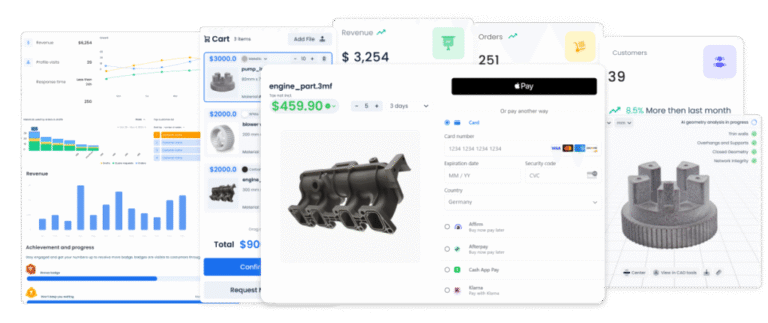
Unlock the secret to providing instant 3D printing quotes without compromising accuracy or your bottom line.
In today’s fast-paced world, waiting 48 hours for a 3D printing quote is simply unacceptable. Potential customers are likely to explore other options during that time, leading to lost business. The traditional quoting process, often involving manual calculations, material cost estimations, and machine availability checks, is time-consuming and prone to errors. This delay not only frustrates customers but also ties up valuable engineering and sales resources that could be focused on other critical tasks.
Moreover, the longer it takes to provide a quote, the more likely the customer is to change their design or find a competitor offering a faster turnaround. In a competitive market, speed is a key differentiator. Businesses that can provide instant or near-instant quotes have a significant advantage in attracting and retaining customers. The ability to respond quickly demonstrates efficiency, responsiveness, and a commitment to customer satisfaction, all of which contribute to a stronger brand reputation.
Ultimately, reducing quote turnaround time is not just about speed; it’s about improving the overall customer experience and driving business growth. It’s about streamlining operations, optimizing resource allocation, and leveraging technology to gain a competitive edge. Embracing instant pricing is a strategic imperative for 3D printing businesses looking to thrive in the modern manufacturing landscape.
Before implementing instant pricing, it’s crucial to identify the bottlenecks in your current quoting process. This involves analyzing each step, from receiving the initial request to delivering the final quote. Common bottlenecks include manual data entry, complex geometry analysis, material price fluctuations, machine scheduling conflicts, and approval workflows. Mapping out the entire process and tracking the time spent on each step can reveal areas for improvement.
For example, are engineers spending excessive time manually calculating material usage or support structure requirements? Is there a lack of integration between your CAD software, quoting system, and production planning tools? Are material prices updated regularly to reflect market changes? Addressing these bottlenecks requires a combination of process optimization, technology adoption, and employee training. Consider investing in software that automates geometry analysis, material cost estimation, and machine scheduling. Implement standardized workflows to ensure consistency and efficiency. Provide employees with the training they need to effectively use new tools and processes.
By streamlining your quoting process, you can significantly reduce turnaround time and improve accuracy. This not only benefits your customers but also frees up your team to focus on more strategic activities, such as design optimization, process improvement, and customer relationship management. A well-optimized quoting process is a foundation for scaling your 3D printing business and achieving sustainable growth.


Automated pricing is the key to achieving instant 3D printing quotes. Several software solutions are available that can automatically analyze 3D models, estimate material costs, calculate printing time, and generate accurate quotes in seconds. These tools typically integrate with CAD software, ERP systems, and production planning tools to provide a seamless workflow. Look for solutions that offer customizable pricing rules, material databases, and machine profiles to ensure accuracy and flexibility.
When implementing automated pricing, it’s essential to define clear pricing strategies that align with your business goals. Consider factors such as material costs, machine depreciation, labor rates, and desired profit margins. Develop pricing rules that automatically adjust prices based on factors such as part complexity, build volume, and lead time. Regularly review and update your pricing strategies to reflect market changes and ensure profitability.
Furthermore, consider offering different pricing tiers based on factors such as lead time and order volume. For example, you could offer a premium price for expedited orders or a discounted price for bulk orders. Providing customers with flexible pricing options can increase sales and improve customer satisfaction. By leveraging the power of automated pricing, 3D printing businesses can provide instant quotes, improve accuracy, and optimize profitability.
While speed is important, accuracy and profitability are equally crucial. Instant quotes should not come at the expense of underestimating costs or sacrificing profit margins. To ensure accuracy, invest in software that uses advanced algorithms to analyze 3D models and estimate material usage and printing time. Regularly calibrate your printers and update your material databases to reflect actual costs. Implement quality control measures to minimize the risk of errors and rework.
To maintain profit margins, carefully consider all costs associated with 3D printing, including material costs, labor rates, machine depreciation, energy consumption, and overhead expenses. Develop pricing strategies that incorporate these costs and ensure a healthy profit margin. Monitor your actual costs and adjust your pricing accordingly. Consider using cost accounting methods to track the profitability of individual jobs and identify areas for improvement.
Moreover, be transparent with your customers about your pricing policies. Clearly communicate the factors that influence your prices, such as material costs, complexity, and lead time. Providing customers with a clear understanding of your pricing can build trust and improve customer satisfaction. By focusing on accuracy, profitability, and transparency, 3D printing businesses can provide instant quotes without compromising their bottom line.
Instant quoting can be a powerful tool for attracting new customers and driving sales. Promote your instant quoting capabilities on your website, social media channels, and marketing materials. Make it easy for potential customers to upload their 3D models and receive instant quotes. Consider offering a free trial or demonstration of your instant quoting system to showcase its capabilities.
Integrate instant quoting into your sales process by empowering your sales team to provide immediate pricing information to potential customers. Train your sales team to effectively use the instant quoting system and answer any questions that customers may have. Use instant quoting as a competitive differentiator to win new business. Highlight the benefits of instant quoting, such as faster turnaround times, improved accuracy, and greater transparency.
Furthermore, use the data generated by your instant quoting system to gain insights into customer behavior and preferences. Analyze the types of parts that customers are requesting quotes for, the materials they are interested in, and the prices they are willing to pay. Use this information to refine your marketing strategies, optimize your pricing policies, and develop new products and services. By integrating instant quoting into your sales and marketing strategy, you can attract more customers, increase sales, and gain a competitive advantage.
Key Takeaways